|
Who knows what evil may lurk in the hearts of attics and
crawlspaces? The Energy Detectives know, beyond the shadow of a doubt.
My name is Kidd. My partner’s name is
Porterfield. It was fall 2004 when we were called to a house in Chicago's Roscoe
Village. The “village” is one of those chichi neighborhoods where rehab
contractors have been enjoying a feeding frenzy for some time now. The house was
one of their wondrous rehabs.
Contractors have a knack for taking a 90-year old
house and making it look marvelous and new. But the homeowner complained of ice
dams, uneven temperatures from room to room, and a basement that was
uninhabitable in winter. When we looked under the makeup of this latest makeover
victim, the body was oozing heat everywhere.
We put the house through our standard series of
tests including an infrared scan and a blower door test. We’re not easily
surprised, but there at the second floor ceiling registers, we found duct
leakage that went off the scale. Obviously the answer would be in the attic but
that’s when we bumped our head against another surprise. The rehab contractor
had sewn up the job without leaving an access hatch to the attic. We couldn’t
get to the source.
Fortunately, the homeowner was game and with her
permission we cut a new access hole into the attic. Ready for surprise number
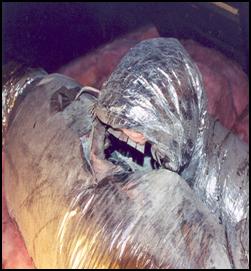
three, we found something astonishing. A few feet from our new hatch was a
monster with a mouth full of sharp teeth ready to devour all prey in its path.
It was ductwork with a break in a supply duct so large you could drive a truck
through— a toy truck anyway— and it sucked the heat right out of the living
spaces.
The pieces of the puzzle began to fall into place.
|
|
1. Every time the furnace or air-conditioner cycled on, thousands of cubic feet
of costly conditioned air was blown into the attic. In winter this created
a buildup of heat right under the roof deck.
2. Ice Dams. The ice dams were caused by heat buildup under the roof-deck combined with snow
on top of the roof. The snow melts, runs to the eaves, the water refreezes and voilà, an ice dam is born.
3. Uneven Temperatures. More heat is supplied to the attic via the duct
break than is supplied to some of the habitable rooms.
4. Cold Basement. With that much heat being dumped into the attic, not much
is left for the basement.
We were called on this case 12 years after the rehab, so you can imagine
the massive waste of energy that had been going on. There were other defects,
of course, but fixing this particular problem made a major contribution to
fixing the whole house.
This is the story of ducts and criminal ducting activity. If you’ve been
following our earlier cases, you’ve seen us catch culprits disguised as duct
chases and holes cut through the air pressure boundary to install ducts. Now we’re
turning our flashlights on egregious faults in ducts themselves. My detective
blotter is cluttered with cases of them.
|
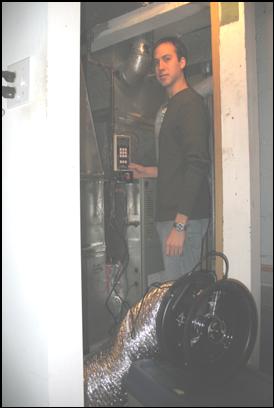
Summer 2006, I was working a job in Skokie, a comfortable suburb on the
north side of Chicago. I had another partner that day, Michael Wyrick, the
new kid on the squad. We were working our way through a 105º attic with the
usual dust, spider webs and fiberglass particles floating in the air.
Wyrick
just graduated as an aerospace and mechanical engineer. He is obviously
interested in becoming an energy detective because of the “high pay” and the
glamour of the position, that and a deep commitment to the world's environment
and the conviction that too much energy is being squandered in buildings. |
I was
in the lead. Wyrick was my backup when suddenly he called out,
"Wow, this is refreshing! " I backtracked to Wyrick’s position.
There in the midst of the 105º attic was an oasis, a breeze of cool air wafting up through the floorboards.
This cold-air fountain was obviously the result of a break in the ductwork buried somewhere
inside the framing of the building.
I’ll spare you the details. Suffice to say,
we advised our client of the bad news and the good news. The bad news was there’d be
hammers flying to get past the sheetrock
to where the break could be repaired. The good news was, once repaired, the ducts would
be delivering conditioned air where it was needed and not into an empty attic.
| Another
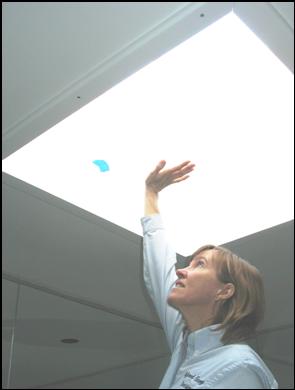
season, fall 2006. I was working a job with Cheryl Pomeroy.
Cheryl is one sharp cookie and the only PhD we have on our staff. {That's Cheryl checking out
a skylight.) Not only is she smart, she really knows her way around a construction site.
You see, Dr. Pomeroy left a promising career as a college professor and spent 13 years
working as a union carpenter. She also has her own home inspection business.
Somehow she finds the time to moonlight with us as an Energy Detective.
You guessed it: she, too, must be motivated by the glamour and the high pay.
The weather was a dreary 35º outside and we were in an attic with a ridge
vent and two gable vents. Logically you would expect this attic to be cold,
right? Well, this attic was 85º. The homeowner had called us in because she
felt like someone was stealing her heat. And she was right. |
|
|
The house
had also been through a renovation in the last few years and the
contractor had placed a furnace and a/c unit in the attic, installed the ridge vent,
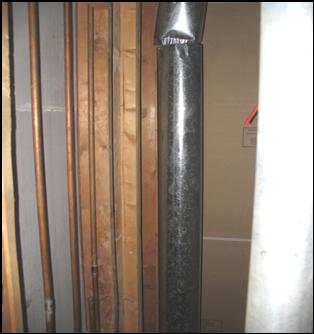
and positioned rigid ductwork across the attic floor. At first sight it looked
pretty good. But under careful observation we found a very leaky setup. Whenever
the furnace cycled on, 130º air spewed out of poor joints in the ductwork at several
locations. The hot air ballooned right through the insulation that wraps the ducts.
No other spot in the house even came close to the temperature in that attic.
|
|
Loosely fitted ductwork lets out lots of air. |
Our client
was in luck. We’re not only good at detecting the problem,
but we come up with pretty good solutions. So we advised our client to get the duct
joints in the unconditioned attic sealed up tight. She was relieved—-could have been
worse.
Not all attics
suffer from too much heat. Just this past week, Pomeroy and I
were diagnosing a single family home in Chicago's Gold Coast and came across
quite the opposite. This fine home, built in the 1880s, had been retrofit
with a high-pressure air-conditioning system located in the attic
crawl space. When we entered through a hatchway in the ceiling of a closet,
the space felt strangely cool to us. A quick check with the digital infrared thermometer
confirmed that the unvented attic was between 68 and 70 degrees Fahrenheit. I'll
let you be the detective on this one. What do you think was going on?
Yep. We found more than a dozen major leaks in the high-pressure duct work.
Whoever installed the ducts had put them together with duct tape. Everybody knows there
are a thousand and one ways to use duct tape but sealing ducts is not one of them.
Duct tape dries out and easily comes loose.
It's no mystery that out of hundreds of buildings we test every year,
the majority has some kind of problem with ductwork. In fact, studies by the Florida
Solar Energy Group show that the average home loses between 10% and 30% of conditioned
air through leaks in the ductwork.
These losses are most critical when the ducts are running though
unconditioned spaces like attics and crawl spaces. Supply-duct leaks can cause
expensive conditioned air to be lost to the outside rather than being delivered
to the building. Return-side-duct openings can draw in air at sharply higher or
lower temperatures, increasing the load on the central equipment. The Minneapolis
Blower Door Company, makers of building diagnostic equipment, estimates that
the addition of 10% of the return air from a hot attic will reduce the efficiency
of an air conditioning system by as much as 30%.
In humid
locations, moisture-laden air drawn into the ducts from basements
and crawl spaces can overwhelm the dehumidification capacity of an air
conditioning system. If the source is a basement, garage or crawlspace,
this air could contain household chemicals, poisons, gasoline, carbon monoxide,
mold spores, dust, paints and other contaminants you don’t want to be caught dead with.
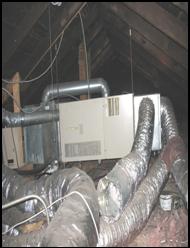
Flex duct is extremely problematic. In recent years it has proliferated in attics
like vines gone wild. Contractors seem to love it, while unsuspecting home buyers
often pay the price.
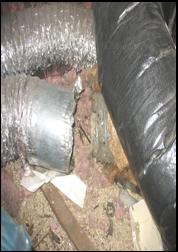
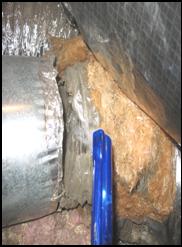
Take a look at this break in a return line that has apparently
gone unnoticed for years. Having a completely open return in the vented attic has
completely sabotaged the ability of the HVAC system to do its job. All this time
the air handling fan has been sucking in thousands of cubic feet of unconditioned
air from the attic and trying to bring it to the desired temperature and humidity.
It has also been sucking in dusty vermiculite insulation, distributing this stuff
throughout the house, clogging the heat exchanger coils and silently working against
the health of the people living there. (That's our blue puffer whose "smoke"
is being sucked into the duct.)
‘Course, these days you might think with cities and states across the
country adopting “energy codes” that call for ductwork to be sealed with
aluminized tape or duct mastic, we’d have an end to this travesty. But our experience
shows many builders pay little attention to energy codes, or, for that matter,
to best practice procedures. A case in point: Chicago has had an energy code
since September 2003 but when I recently checked the shelves in the showroom of
a major HVAC supplier I found only 5 one-gallon cans of duct mastic and they
were covered in dust.
If the
ducts aren't sealed at the time of construction, it is very difficult
to get at them later. After all, they are usually hidden in attics or crawlspaces,
or buried inside of wall and floor cavities.
While
getting an airtight seal on ductwork is very important, it is by no
means the only problem we encounter with ductwork:
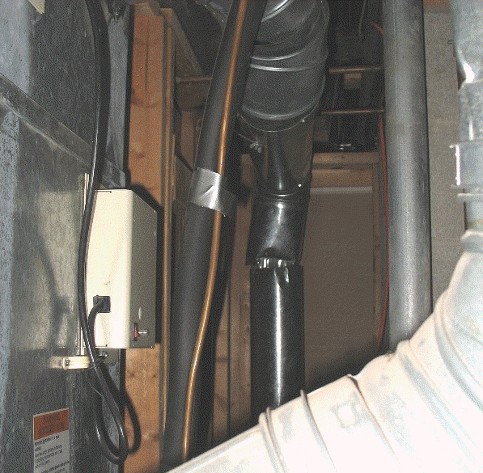
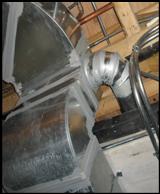
Ducts are often poorly designed or seemingly not designed at all
Imbalances between supply and return cause some parts of the building to
pressurize, pushing conditioned air to the outside, while other sections
depressurize, pulling in outside air. Worse yet this depressurization can cause fireplaces and
combustion equipment to back draft, spilling products of combustion into the building
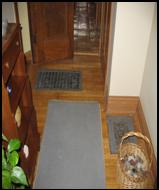
Poor placement of duct registers, insufficient sizing for return air
ducts, restrictions like grills and designer registers made of wood can
compromise the efficiency and output of the system. We have even seen supply
registers and return grills so close together they cancel each other out.
The duct layout can be twisted and tortured, disrupting the flow of conditioned air.
Contractors often use the building's heating and cooling system during
construction, leaving behind dust laden vents and fillers and clogged heat
exchange coils Not only does that cause health problems for the building,
it’s not good for the health of future inhabitants.
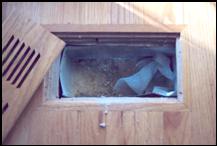
Contractors have even been known to sweep their clean-up debris into the
floor ducts before installing a shiny new floor register. With respiratory
ailments on the rise for all ages, this practice is outrageous.
Leaky ducts can transport moisture-laden air into cold attics or from
damp crawl paces. This in turn can lead to mold growth and indoor air quality issues.
 |
 |
 |
|
 |
 |
|
Just
when we thought things couldn’t get any worse; things got worse.
It was the dead of winter. Dr. Pomeroy, Porterfield and yours truly converged
on the crime scene of a regular Saturday night massacre. We had seen
ducts run through unconditioned spaces before but this house
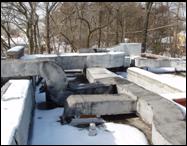
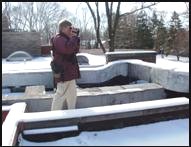
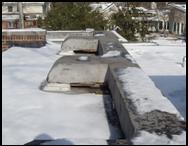
took the cake. There before our very eyes someone had run leaky barely
insulated ductwork across a roof --- in Chicago!!! Could this have something
to do with our client’s $700-800 heating bills!
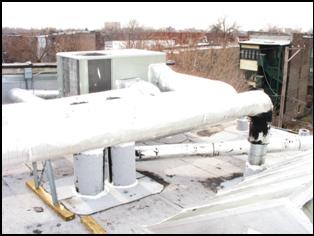
Not long after, Porterfield and Michael reported another unbelievable case.
This time the contractor made no attempt to insulate major sections of the ducts.
 |
 |
 |
 |
|
We're swapping stories at a conclave of the American Society of Heating,
Refrigeration and Air Conditioning Engineers (ASHRAE) when Shawn Mansfield,
another fine energy detective, tells one that beats all. He's in a
house with a mysteriously high 62% relative humidity. You might expect this on
a houseboat, but there was no sign of standing water anywhere.
He was stumped until he sent a mini camera into the underground ducts where it almost
drowned in ground water. Talk about leaky ducts!
By now, you may have figured we’re not just after the energy waste.
Like a lot of other folks in the industry, we believe the goal of
homebuilding and rehab should be to build a quality product that is safe,
healthy, durable and, of course, energy efficient. Poorly designed and installed
ductwork cuts across all of this. It doesn’t have to happen.
As energy consultants and “green building” advisors, the Energy Detectives™
at Informed Energy Decisions are proud to train and identify a growing list of
developers and contractors who build better buildings.
Until it's
time to post our next case, catch us by the car with the sign that says,
"Energy Detectives – we’re on the case to make buildings more energy efficient."
| | |